Clinical Pearl · Cardiomyopathy
VUS, I Have a Beef With You!
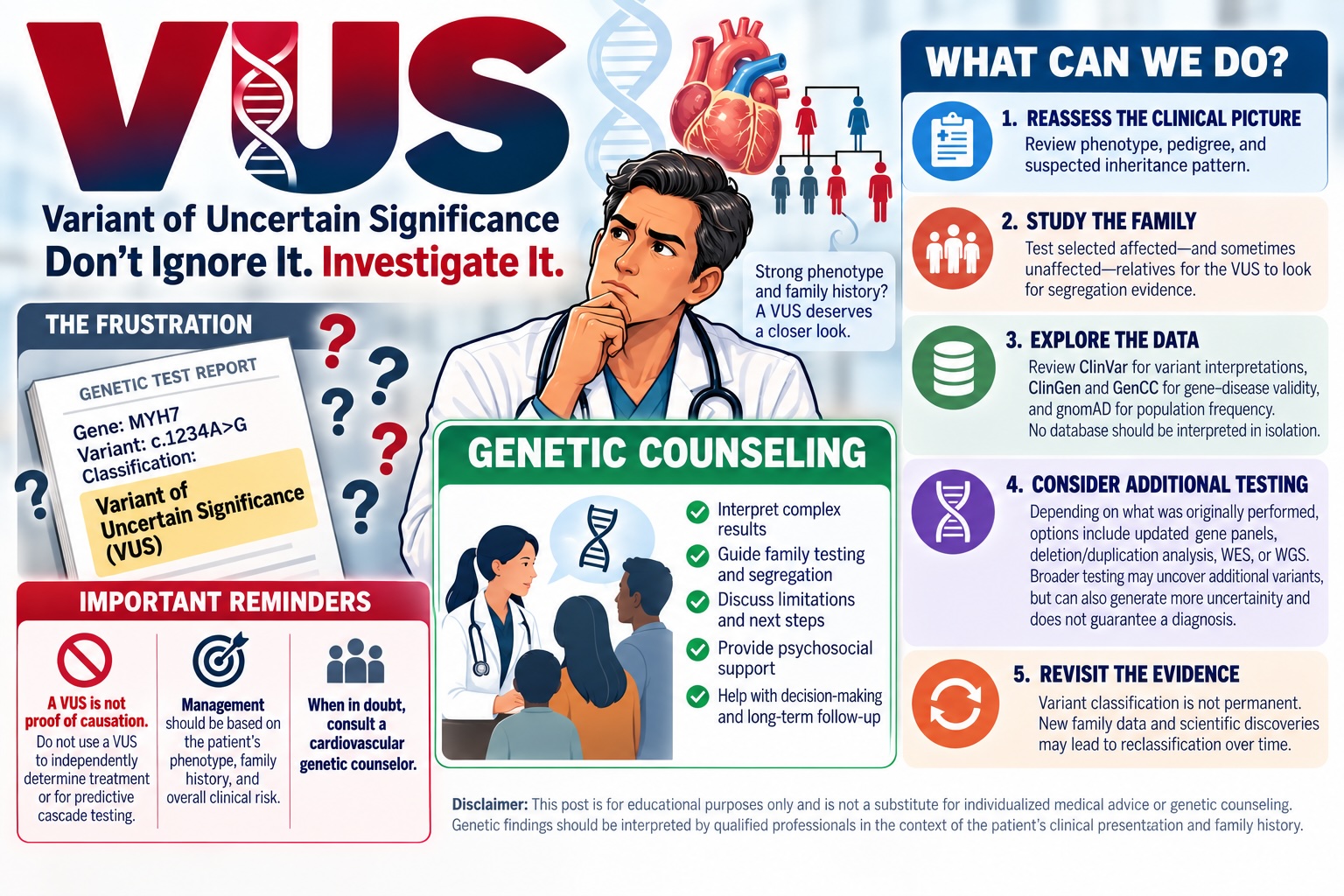
Variant of Uncertain Significance: Don’t Ignore It. Investigate It.
Genetic testing has transformed our understanding of inherited cardiomyopathies. But one result continues to frustrate clinicians and families alike: the variant of uncertain significance (VUS).
You order genetic testing hoping for answers. Instead, you get uncertainty. A variant is identified, but we still don’t know whether it explains the disease. This becomes particularly frustrating when the phenotype and family history strongly suggest an inherited cardiomyopathy.
But uncertainty should not mean the end of the investigation.
I have encountered families in which parents and children have cardiomyopathy, yet genetic testing identifies only a VUS. These cases deserve a closer look.
So what can we do?
Look beyond the report. Reassess the phenotype, pedigree, and suspected inheritance pattern.
Study the family. Testing carefully selected affected—and sometimes unaffected—relatives for the VUS can provide segregation evidence that may help clarify its significance.
Explore the evidence. Review ClinVar for variant interpretations, ClinGen and GenCC for gene–disease validity, and gnomAD for population frequency. No database should be interpreted in isolation.
Consider additional testing. Depending on what was originally performed, updated panels, deletion/duplication analysis, WES, or WGS may uncover variants that were previously missed. Broader testing, however, can also produce more uncertainty and does not guarantee an answer.
Revisit it. Variant classification is not necessarily permanent. New family information, functional data, population data, and scientific discoveries may eventually lead to reclassification.
The critical principle: A VUS is not proof of causation and should not independently determine treatment or be used for predictive cascade testing. Clinical screening and management should remain grounded in the phenotype, family history, and overall clinical risk.
My beef with the VUS isn’t that it leaves us without an immediate answer. It’s when we let uncertainty stop us from asking the next question.
Don’t overinterpret the variant. Don’t overlook the family. And when the phenotype strongly suggests inherited disease, don’t stop investigating simply because the report says “uncertain.”
When in doubt, involve a cardiovascular genetic counselor.
Disclaimer: Educational purposes only. This is not a substitute for individualized medical advice or genetic counseling. Genetic findings should be interpreted by qualified professionals in the context of the patient’s phenotype and family history.
#Cardiomyopathy #CardiovascularGenetics #GeneticTesting #VUS #ClinGen #ClinVar #WES #WholeGenomeSequencing #PrecisionMedicine #InheritedHeartDisease #GeneticCounseling #Cardiogenetics
Important notice
This content is for educational purposes only and is not medical advice for any individual patient. Patients should discuss diagnosis and treatment decisions with their own physician, or request a clinical consultation.