← Clinical Pearls

Clinical Pearl · Systems of Care

Should We Routinely Measure AV Fistula Flow in Dialysis Patients With Heart Failure?

In dialysis patients with heart failure, we routinely assess volume status, EF, pulmonary pressures, valves, and cardiac output. But how often do we ask: what is the flow through the AV fistula?

AV fistulas create a continuous circulatory shunt. Typical flows vary by location:

• Forearm/radiocephalic AVF: ~500–1,000 mL/min

• Upper-arm/brachial-based AVF: ~1,000–2,000 mL/min or more

• High-flow AVF: often considered Qa >2 L/min

But perhaps the more interesting number is Qa/CO—the percentage of total cardiac output going through the access. A Qa of 2.1 L/min with a CO of 6.2 L/min means approximately 34% of cardiac output is passing through the fistula.

In a patient with limited cardiac reserve, could that flow itself be contributing to heart failure?

This is where heart failure cardiologists and nephrologists need to collaborate. The fistula is the patient's dialysis lifeline, but its hemodynamic burden shouldn't be overlooked.

Should Qa routinely be checked and be part of hemodialysis patients' routine measurements?

Educational purposes only.

#HeartFailure #Nephrology #Hemodialysis #CardioNephrology #AVFistula #Cardiorenalsyndrome #CRS
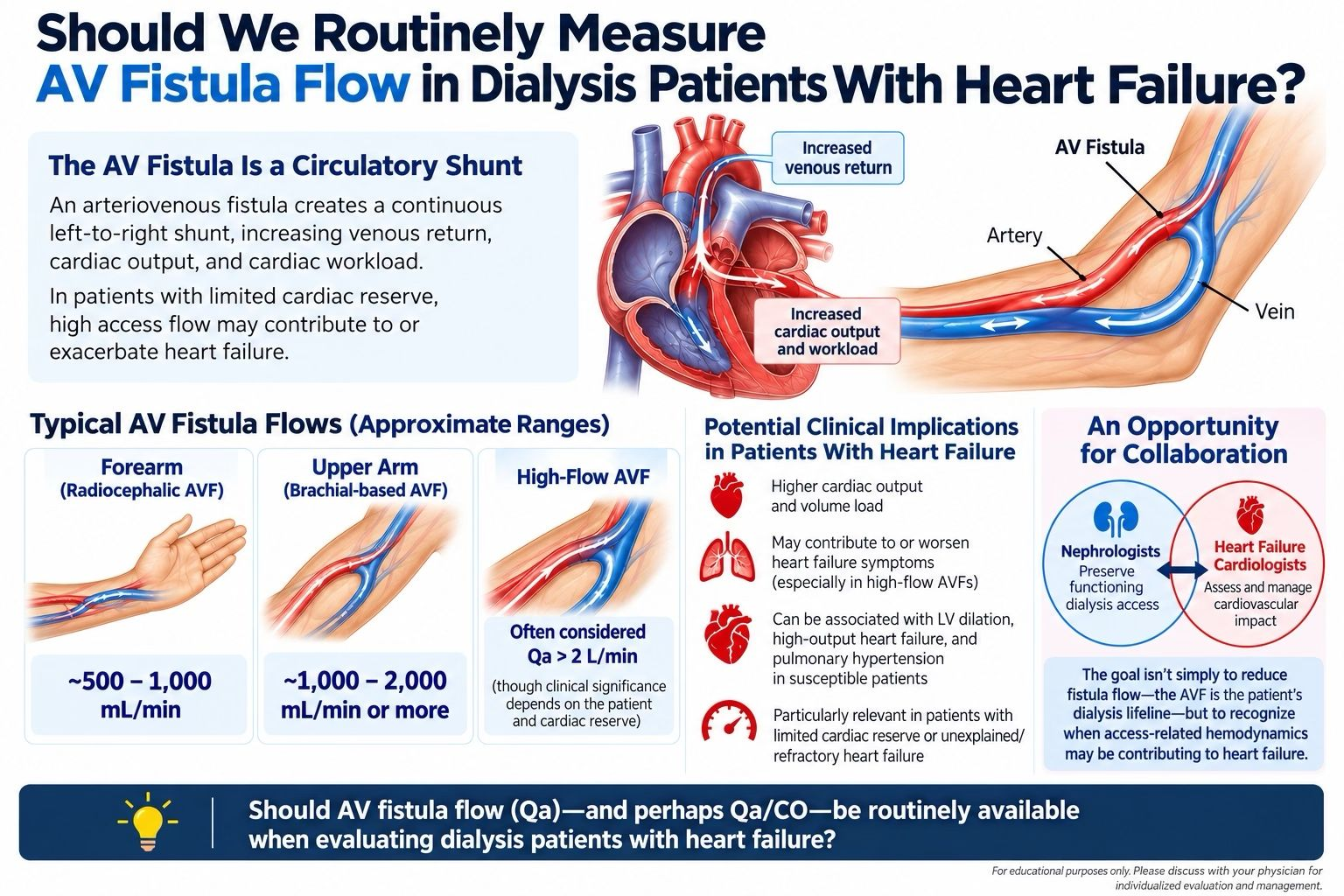
AV fistula flow in dialysis patients with heart failure infographic: the AV fistula is a circulatory shunt — an arteriovenous fistula creates a continuous left-to-right shunt, increasing venous return, cardiac output, and cardiac workload, and in patients with limited cardiac reserve high access flow may contribute to or exacerbate heart failure, illustrated with a heart connected to an arm showing artery, vein, and AV fistula. Typical AV fistula flows (approximate ranges): forearm/radiocephalic AVF ~500–1,000 mL/min, upper-arm/brachial-based AVF ~1,000–2,000 mL/min or more, and high-flow AVF often considered Qa >2 L/min though clinical significance depends on the patient and cardiac reserve. Potential clinical implications in patients with heart failure: higher cardiac output and volume load; may contribute to or worsen heart failure symptoms, especially in high-flow AVFs; can be associated with LV dilation, high-output heart failure, and pulmonary hypertension in susceptible patients; particularly relevant in patients with limited cardiac reserve or unexplained or refractory heart failure. An opportunity for collaboration: nephrologists preserve functioning dialysis access while heart failure cardiologists assess and manage cardiovascular impact — the goal isn't simply to reduce fistula flow, the AVF is the patient's dialysis lifeline, but to recognize when access-related hemodynamics may be contributing to heart failure. Closing question: should AV fistula flow (Qa), and perhaps Qa/CO, be routinely available when evaluating dialysis patients with heart failure?

Important notice

This content is for educational purposes only and is not medical advice for any individual patient. Patients should discuss diagnosis and treatment decisions with their own physician, or request a clinical consultation.

More in Systems of Care