Perspective · Systems of Care
Heart Failure Care Is Never a One-Person Job: The Caregiver Needs a Care Team Too
In heart failure, we spend enormous amounts of time discussing GDMT, hemodynamics, devices, remote monitoring, LVADs, and transplantation. But another intervention quietly holds much of this together: social support.
Anyone caring for advanced HF patients knows how important caregivers are. They manage medications, recognize worsening edema, arrange transportation, attend appointments, reinforce education, and often become the first person to recognize clinical deterioration. For years, transplant evaluation often distilled this complex ecosystem into a simple question: “Who is the caregiver?” Inadequate caregiver support could become a major barrier to transplantation.
The recent 2026 ISHLT Expert Consensus Statement on social support systems offers an important evolution in this thinking. Rather than focusing solely on the presence of a designated caregiver, it emphasizes the broader social support system capable of providing medical, logistical, emotional, informational, psychological, and companionship support throughout the patient's journey.
Figure 1 captures this beautifully. The patient is at the center, surrounded by the caregiver—but the caregiver is also surrounded by a larger ecosystem: family and friends, neighbors and community, faith communities, healthcare teams, support groups and mental-health resources, governmental/social services, and insurance resources.
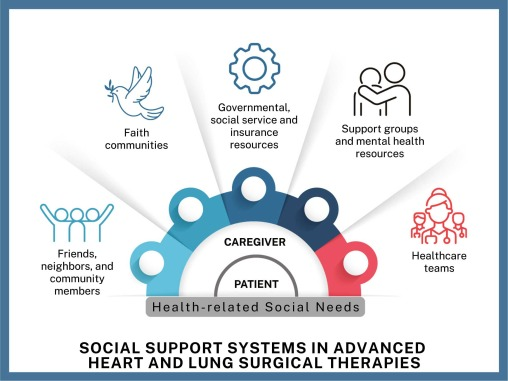
This distinction matters. The caregiver remains essential, but we cannot expect one spouse, child, parent, or friend to simultaneously become the patient's nurse, pharmacist, transportation service, dietitian, medication manager, psychologist, financial counselor, and emergency-response system. Heart failure is a chronic journey that can span years of hospitalizations, medication changes, worsening frailty, LVAD or transplant evaluation, and difficult end-of-life decisions. Caregiver burnout is real, and caregivers need support too.
Perhaps the better question is evolving from “Does this patient have a caregiver?” to “Does this patient have a reliable social support system capable of meeting the needs of advanced therapy?” That is both more practical and potentially more equitable. A patient without a spouse or traditional family structure is not necessarily unsupported. Friends, neighbors, faith communities, healthcare systems, social services, home health, transportation programs, and other resources can perform different parts of the caregiving function.
And this concept extends far beyond transplantation. When we discharge a patient after decompensated HF, we should ask not only, “What medications are they going home on?” but also, “Who—or what system—is going home with them?” Who will recognize congestion, understand the diuretic plan, obtain medications, ensure follow-up, and call when something changes? And equally important: who is supporting the person doing all of that?
Social support is not an accessory to heart failure care. It is part of the treatment. The next evolution in advanced HF care may not simply be identifying caregivers—it may be building systems around them. Because when we support the caregiver, we ultimately support the patient.
Reference: McIlvennan CK, Anthony SJ, Dobbels F, et al. Engagement of Social Support Systems in Patients Being Considered for and Following Advanced Heart and Lung Surgical Therapies: An ISHLT Expert Consensus Statement. J Heart Lung Transplant. 2026. doi:10.1016/j.healun.2026.07.037.
#HeartFailure #AdvancedHeartFailure #HeartTransplant #LVAD #Caregivers #CaregiverSupport #SocialSupport #HealthEquity #PatientCenteredCare #Cardiology #ISHLT #TransplantCardiology
Important notice
This content is for educational purposes only and is not medical advice for any individual patient. Patients should discuss diagnosis and treatment decisions with their own physician, or request a clinical consultation.