July 10, 2026 · Clinical Pearl · Systems of Care
Should Cardiac Rehabilitation Be Part of GDMT for Heart Failure?
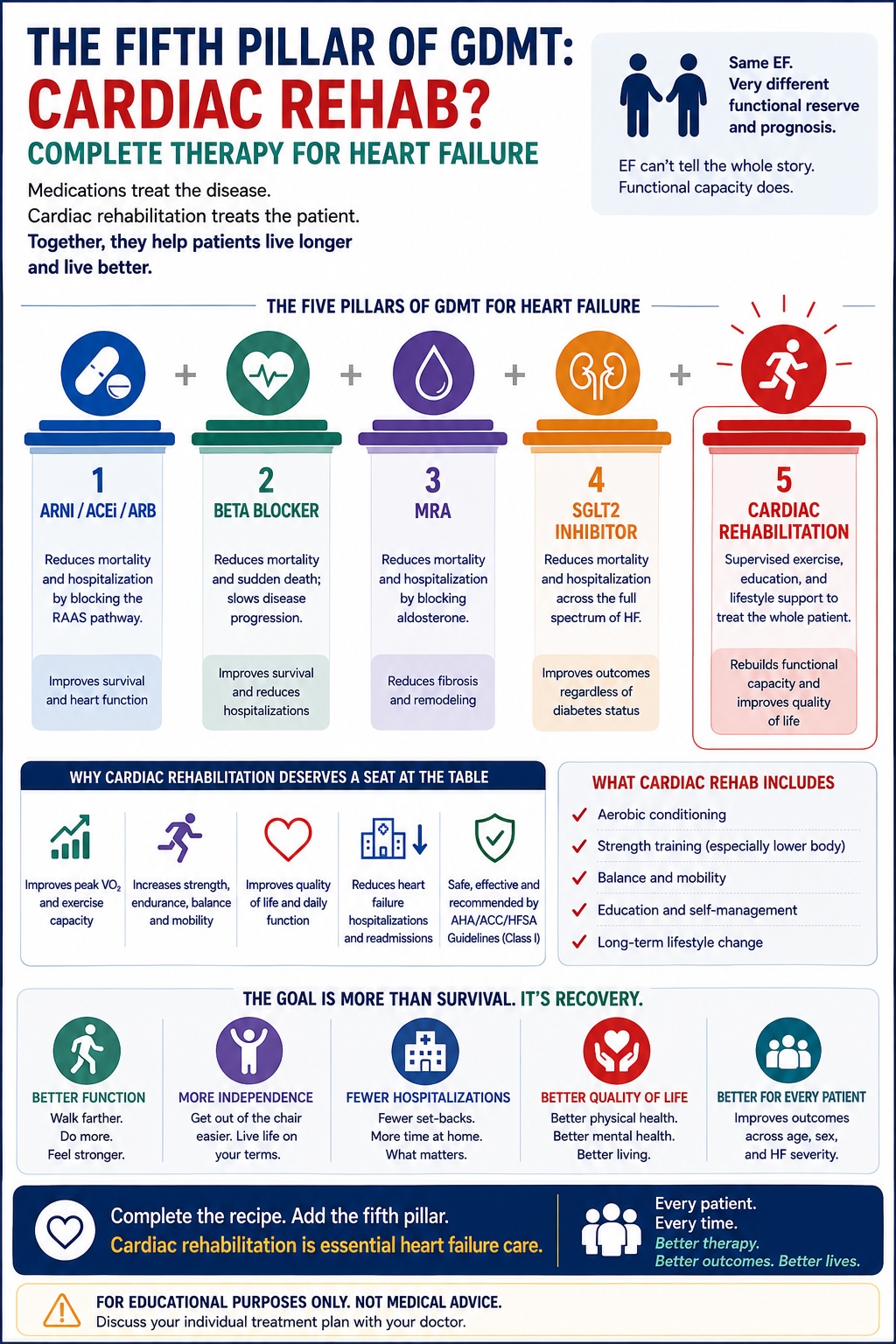
Cardiac rehabilitation (CR) is a structured program of supervised exercise, education, and lifestyle support that helps heart failure patients rebuild functional capacity and quality of life.
Heart failure can lead to:
Skeletal-muscle weakness and deconditioning
Impaired peripheral oxygen utilization
Reduced endurance
Loss of lower-extremity strength
Frailty and impaired mobility
GDMT improves cardiac biology. Diuretics restore euvolemia. But neither automatically restores physical function.
That is where cardiac rehabilitation (CR) becomes important.
The 2022 AHA/ACC/HFSA guidelines give exercise training a Class I recommendation for appropriate HF patients to improve functional status, exercise performance and quality of life.
CR can improve:
Peak VO₂ and aerobic fitness
Functional capacity and endurance
Lower-extremity strength
Balance and mobility
Quality of life
HF hospitalization risk
Importantly, cardiac rehab is much more than a treadmill. Modern rehabilitation incorporates aerobic conditioning, resistance training, mobility, balance, education and long-term lifestyle change.
Making CR part of our CHF pathway
At Sharp Chula Vista, every appropriate hospitalized CHF patient is referred for cardiac rehabilitation.
Our philosophy is simple:
If rehabilitation is important enough to recommend, it should be built into the system of care—not left as an afterthought.
As part of our New Frontiers HF initiative, we are looking to take this further:
Identify frailty and functional limitations earlier
Emphasize lower-extremity strength, balance and mobility
Improve the transition from hospital → cardiac rehab → community exercise
Develop community partnerships for continued physical activity
Track functional recovery alongside EF, weight and laboratory values
Perhaps we should expand how we think about comprehensive HF therapy:
GDMT → improve cardiac biology and survival
Diuresis → restore euvolemia
Devices/procedures → address structural and electrical disease
Cardiac rehabilitation → rebuild functional reserve
We measure EF, BNP, creatinine, potassium and weight.
Maybe we should also measure whether our patients can walk farther, get out of a chair more easily and regain their independence.
Successful heart failure treatment shouldn't simply help patients live longer—it should help them live better.
#HeartFailure #CardiacRehabilitation #GDMT #CHF #Cardiology #ExerciseMedicine #HeartFailureCare #SharpHealthCare #SharpChulaVista #SharpChulaVistaMedicalCenter #SharpHeartAndVascular
Important notice
This content is for educational purposes only and is not medical advice for any individual patient. Patients should discuss diagnosis and treatment decisions with their own physician, or request a clinical consultation.