September 5, 2026 · Clinical Pearl · HFrEF
Amiodarone in Heart Failure: Are We Monitoring Enough?
Amiodarone is frequently used in patients with heart failure—particularly when atrial or ventricular arrhythmias coexist with reduced EF. But prescribing amiodarone should probably come with something else: a monitoring plan.
Amiodarone is frequently used in patients with heart failure—particularly when atrial or ventricular arrhythmias coexist with reduced EF.
But prescribing amiodarone should probably come with something else: a monitoring plan.
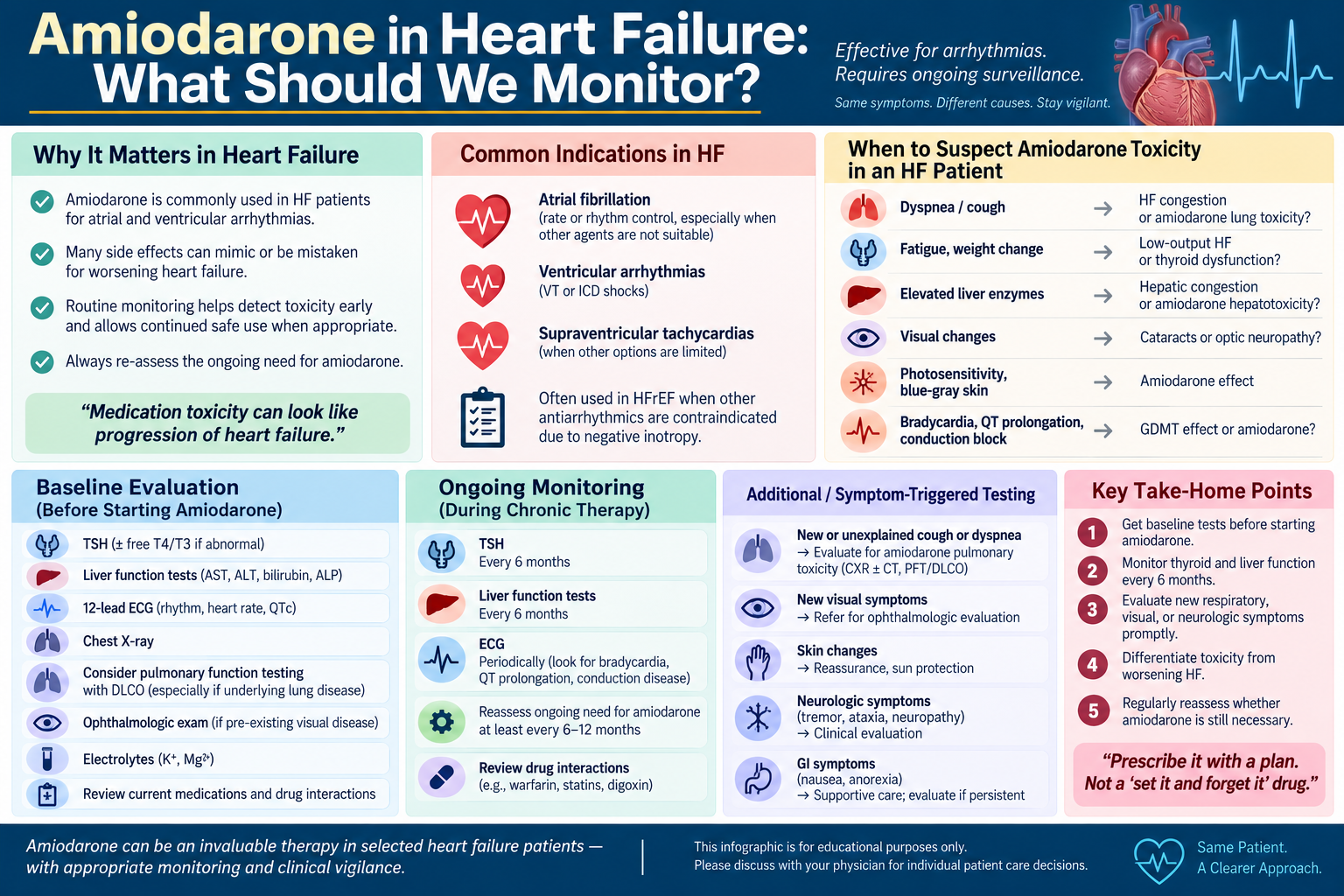
The challenge is that several manifestations of amiodarone toxicity can look remarkably similar to worsening heart failure.
Dyspnea → HF congestion or amiodarone lung toxicity?
Fatigue → low-output HF or thyroid dysfunction?
Elevated liver enzymes → hepatic congestion or amiodarone toxicity?
Bradycardia → beta-blocker/GDMT effect or amiodarone?
That makes surveillance especially important in the HF population.
Before starting amiodarone
Consider establishing a baseline:
TSH ± free T4/T3 if abnormal
Liver function tests
ECG — rhythm, heart rate, QTc
Chest X-ray
Potassium and magnesium
Consider pulmonary function testing/DLCO when clinically appropriate
During chronic therapy
Every 6 months:
→ TSH
→ Liver function tests
→ Reassess whether amiodarone is still necessary
ECG surveillance:
→ Bradycardia
→ QT prolongation
→ Conduction disease
New cough or unexplained dyspnea:
→ Don’t automatically assume it’s CHF.
→ Consider amiodarone pulmonary toxicity and obtain appropriate chest imaging.
Routine serial PFT/DLCO screening in every asymptomatic patient is less clearly supported; current ACC/AHA AF guidance emphasizes baseline chest radiography and symptom-triggered evaluation, with CT particularly useful when unexplained cough or dyspnea develops.
Similarly, routine ophthalmologic screening isn’t necessarily required for everyone, but new visual symptoms warrant evaluation.
The bigger issue
In heart failure, medication toxicity can masquerade as progression of the disease itself.
Before escalating diuretics for unexplained dyspnea, attributing fatigue to advanced HF, or blaming abnormal LFTs on congestion—ask whether amiodarone could be contributing.
Amiodarone can be an extremely useful drug in selected HF patients.
But long-term amiodarone should rarely be a “prescribe it and forget it” medication.
#HeartFailure #Amiodarone #Cardiology #Electrophysiology #AtrialFibrillation #Arrhythmia #HFrEF #PatientSafety
Important notice
This content is for educational purposes only and is not medical advice for any individual patient. Patients should discuss diagnosis and treatment decisions with their own physician, or request a clinical consultation.