Perspective · HFrEF
AFib + CHF: Rate Control Won the Debate. Then Ablation Changed the Rules.
Rhythm control may not have failed. The way we were achieving rhythm control may have failed.
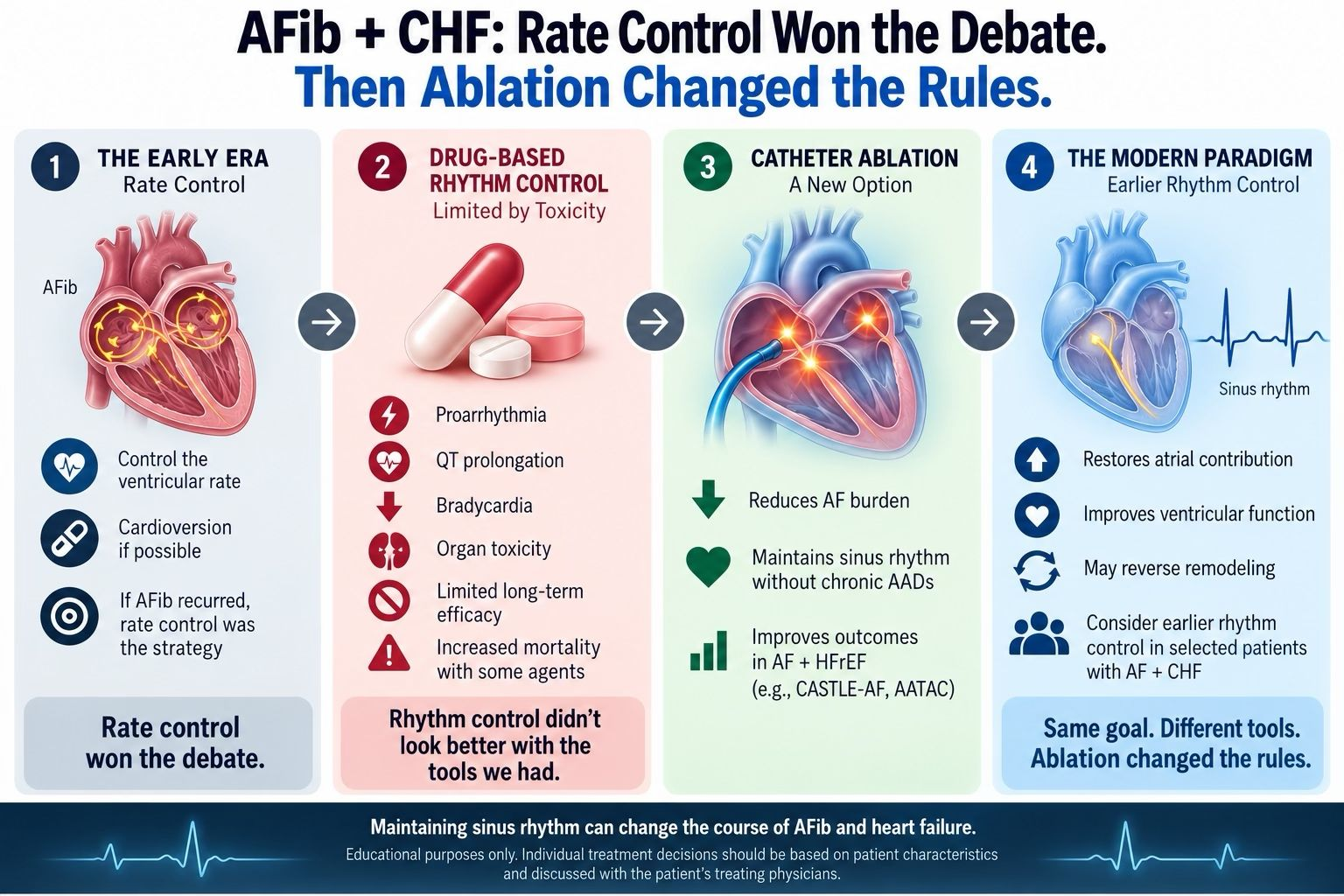
For years, the conventional approach to atrial fibrillation in heart failure was pretty straightforward: control the rate. Cardiovert when appropriate. Try to restore sinus rhythm if reasonable.
But if AFib came back? Accept it. Control the ventricular rate. Move on. Why? Because the early rate-control vs rhythm-control trials failed to show the advantage of rhythm control that many expected.
The conclusion seemed obvious: rate control won. Rhythm control didn’t. But maybe we got the lesson wrong. Rhythm control may not have failed. The way we were achieving rhythm control may have failed.
At the time, rhythm control meant using antiarrhythmic drugs. With these drugs we had to deal with:
→ Proarrhythmia → QT prolongation → Bradycardia → Organ toxicity → Drug interactions → Limited long-term efficacy → And, with some drugs and populations, increased mortality
Then came catheter ablation. And suddenly, we weren’t playing by the same rules. Rather than simply suppressing AFib pharmacologically, catheter ablation gave us another way to reduce AF burden and maintain sinus rhythm without relying solely on chronic antiarrhythmic therapy.
Trials such as AATAC and CASTLE-AF helped demonstrate that catheter ablation could improve meaningful outcomes in appropriately selected patients with heart failure. And biologically, this makes sense.
AFib in heart failure isn’t always an innocent bystander. Persistent AFib can mean:
→ Loss of atrial contribution → Irregular ventricular activation → Rapid ventricular rates → Reduced cardiac efficiency → Neurohormonal activation → Functional mitral/tricuspid regurgitation → Progressive atrial and ventricular remodeling → AF-mediated cardiomyopathy
Sometimes AFib isn’t simply a consequence of heart failure. It may be helping drive it.
So perhaps the great rate vs rhythm debate taught us the wrong lesson. We thought: rhythm control doesn’t work. What we may actually have learned was: rhythm control with the tools we had at the time didn’t work well enough.
Now the tools have changed. Rate control → drug-based rhythm control → catheter ablation → earlier rhythm control.
In appropriately selected patients—particularly those with HFrEF or suspected AF-mediated cardiomyopathy—simply asking “Is the rate controlled?” may no longer be enough.
Perhaps the better question is: “Why are we accepting AFib in this patient?”
Rate control won the original debate. Catheter ablation changed the rules.
#AFib #AtrialFibrillation #HeartFailure #CHF #HFrEF #HFpEF #RhythmControl #RateControl #CatheterAblation #AFAblation #CardiacAblation #Electrophysiology #CardiacElectrophysiology #EP #Cardiology #HeartRhythm #SinusRhythm #Arrhythmia #Cardiomyopathy #AFMediatedCardiomyopathy #TachycardiaMediatedCardiomyopathy #CASTLEAF #AATAC
Important notice
This content is for educational purposes only and is not medical advice for any individual patient. Patients should discuss diagnosis and treatment decisions with their own physician, or request a clinical consultation.