August 11, 2026 · Clinical Pearl · HFrEF
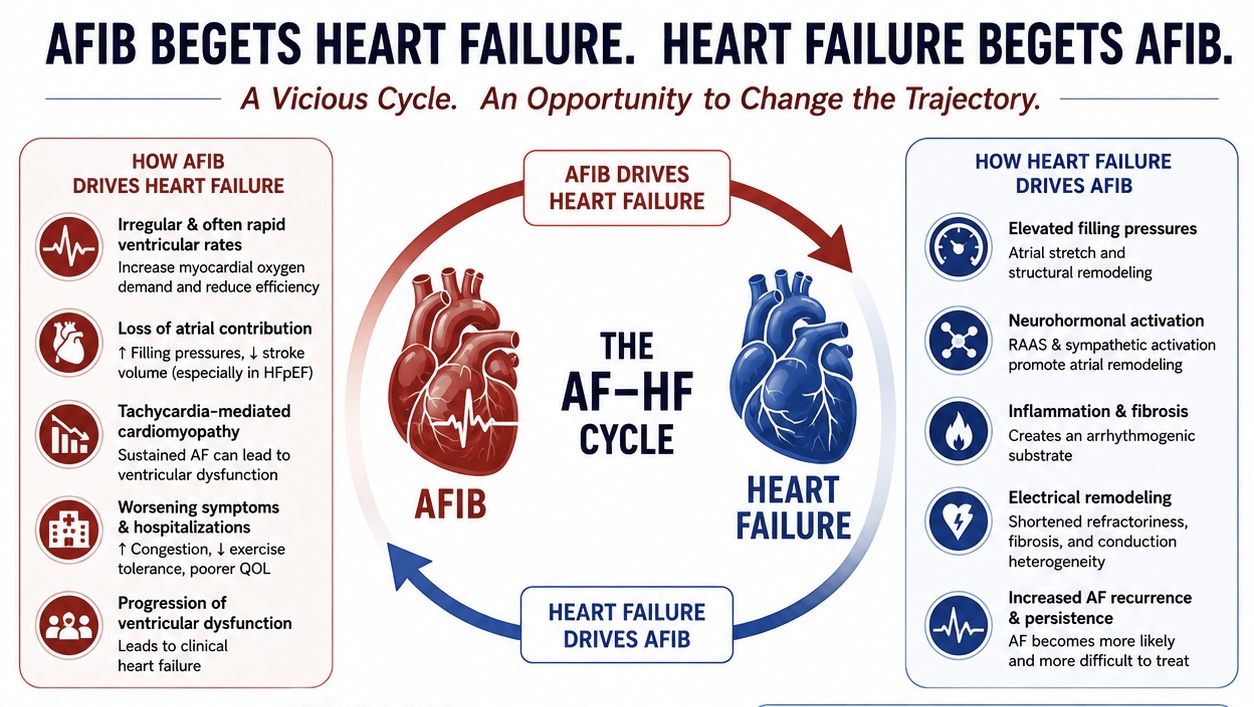
AFib Begets Heart Failure. Heart Failure Begets AFib.
A vicious cycle. An opportunity to change the trajectory.
Atrial fibrillation can lead to rapid and irregular ventricular rates, loss of atrial contribution, impaired filling, and ultimately worsening ventricular function and heart failure.
At the same time, heart failure creates the perfect substrate for AFib—elevated filling pressures, atrial stretch, neurohormonal activation, inflammation, and progressive atrial remodeling.
AFib → HF → more AFib → worsening HF.
The CASTLE-AF trial helped reinforce an important concept: In patients with symptomatic AF, NYHA II–IV heart failure and LVEF ≤35%, catheter ablation compared with medical therapy was associated with a 38% relative reduction in death or HF hospitalization, a 47% relative reduction in all-cause mortality, and a 44% relative reduction in HF hospitalization.
What about HFpEF? The next frontier is understanding whether earlier and more aggressive rhythm control can break this cycle across the broader spectrum of heart failure, particularly HFpEF and HFmrEF.
We are eagerly awaiting results from ongoing trials such as CASTLE-HFpEF, CABA-HFPEF, and STABLE-SR IV to help define what comes next.
The key is recognizing when AFib is not simply a consequence of heart failure, but an active driver of it.
Break the AFib–HF cycle early.
#HeartFailure #AFib #AtrialFibrillation #HFrEF #HFpEF #CASTLEAF #Cardiology #Electrophysiology #CatheterAblation
Important notice
This content is for educational purposes only and is not medical advice for any individual patient. Patients should discuss diagnosis and treatment decisions with their own physician, or request a clinical consultation.