Clinical Pearl · Pulmonary Hypertension
PAH: The Era of Four-Pathway Therapy?
For years, pulmonary arterial hypertension treatment has focused on three pathways. Now there is a fourth—activin signaling—and the question is shifting from whether it belongs in the arsenal to how early we should use it.
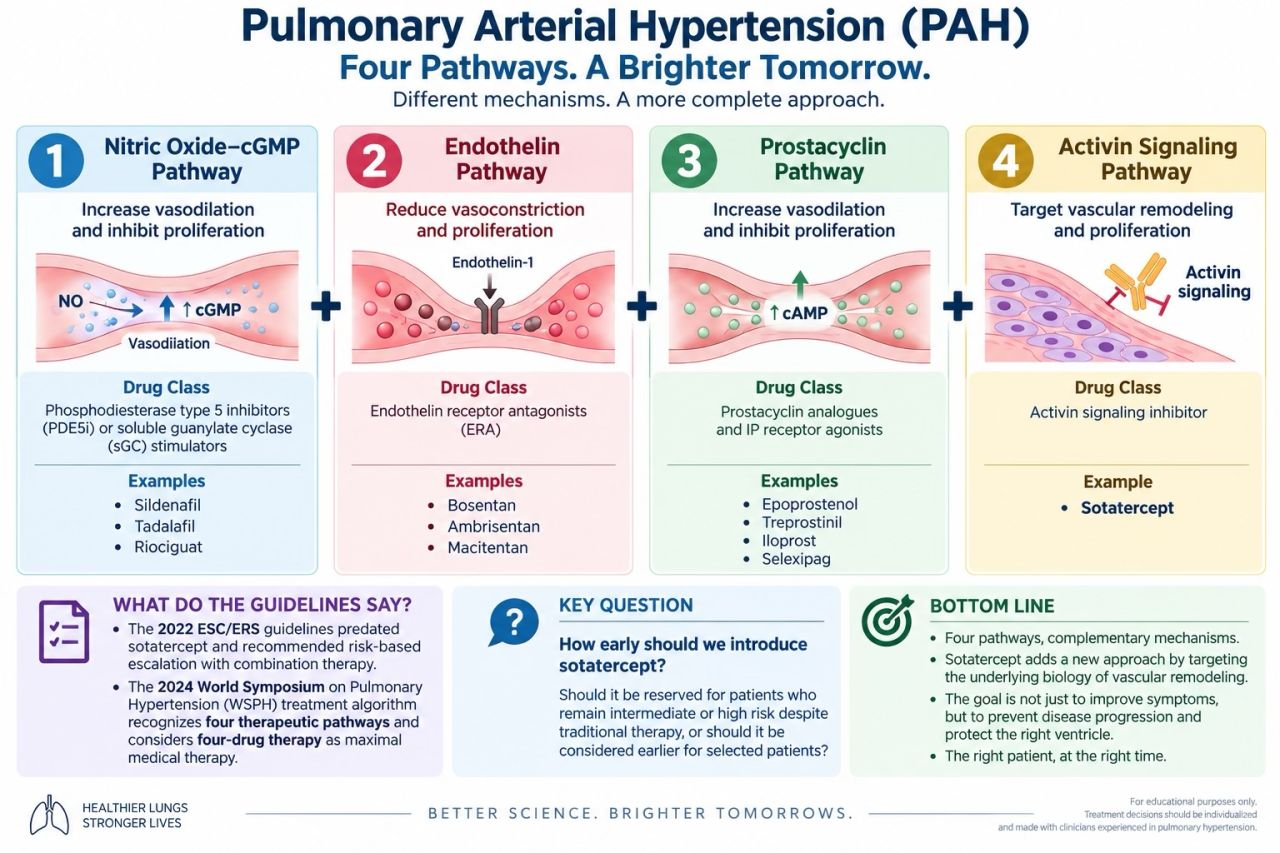
For years, pulmonary arterial hypertension treatment has focused on three pathways:
• Nitric oxide–cGMP: PDE5 inhibitors or sGC stimulators
• Endothelin: endothelin receptor antagonists
• Prostacyclin: prostacyclin analogues or IP receptor agonists
Now there is a fourth: activin signaling, with sotatercept.
This is not simply another pulmonary vasodilator. Sotatercept targets abnormal signaling involved in pulmonary vascular proliferation and remodeling.
And the evidence is building:
• STELLAR: improved exercise capacity, hemodynamics, and measures of disease severity.
• ZENITH: reduced death, lung transplantation, or hospitalization for worsening PAH in high-risk patients—many already on triple therapy.
• HYPERION: reduced clinical worsening in recently diagnosed patients who remained intermediate or high risk despite background therapy.
The 2024 World Symposium on Pulmonary Hypertension treatment algorithm now recognizes these four therapeutic pathways and describes four-drug therapy as maximal medical therapy.
So perhaps the question is no longer whether PAH has a fourth therapeutic pathway. The question is how early should we use it?
Are we heading toward earlier four-pathway therapy for selected patients rather than waiting for failure of traditional triple therapy?
The PAH paradigm continues to evolve: nitric oxide + endothelin + prostacyclin + activin signaling.
Four pathways. Different mechanisms. One goal: prevent disease progression and protect the right ventricle.
Educational purposes only. Treatment decisions should be individualized.
#PulmonaryHypertension #PAH #Sotatercept #Winrevair #Cardiology #HeartFailure #RightHeartFailure
Important notice
This content is for educational purposes only and is not medical advice for any individual patient. Patients should discuss diagnosis and treatment decisions with their own physician, or request a clinical consultation.