Clinical Pearl · HFpEF
“HFpEF Exacerbation”: Are We Looking Deeply Enough?
Dyspnea. Edema. Weight gain. An EF of 60%. Too often, the admission diagnosis becomes automatic. But preserved LV EF does not tell us what is driving the congestion.
Dyspnea. Edema. Weight gain. An EF of 60%. Too often, the admission diagnosis becomes automatic: “acute on chronic HFpEF exacerbation.”
But preserved LV EF does not tell us what is driving the congestion.
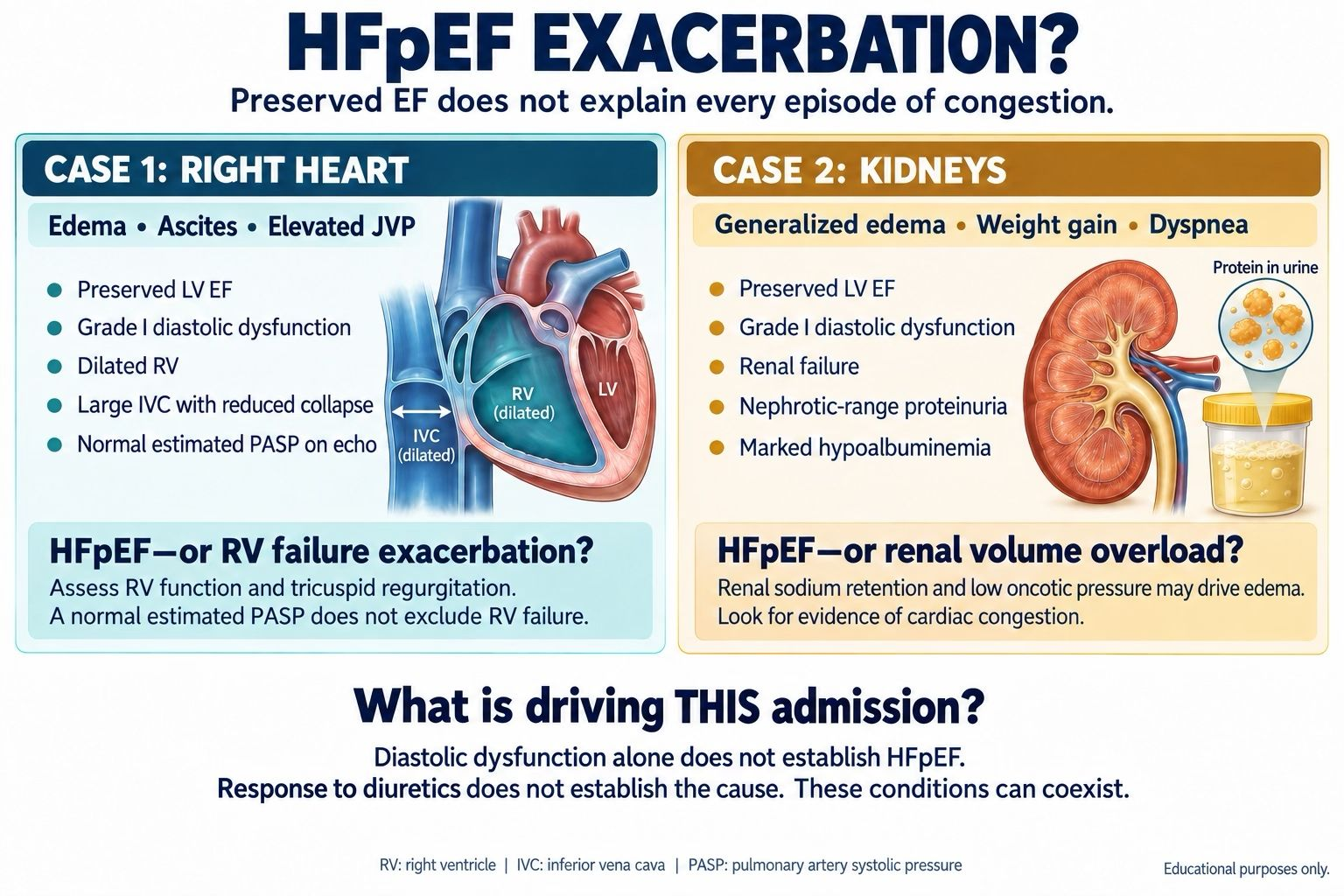
Example 1: Is the right ventricle driving the admission?
A patient presents with worsening edema, abdominal distension, and elevated JVP. The echo shows:
• Preserved LV EF
• Grade I diastolic dysfunction
• A dilated RV
• A large IVC with reduced inspiratory collapse
• A reportedly normal estimated PASP
Is this an HFpEF exacerbation, or predominantly a right ventricular failure exacerbation?
Grade I diastolic dysfunction alone does not establish elevated left-sided filling pressures. RV dilation and a plethoric IVC should prompt closer assessment of RV function, tricuspid regurgitation, and systemic venous congestion. A normal estimated PASP does not exclude RV failure. RV failure can occur without pulmonary hypertension, and echo pressure estimates have limitations.
Example 2: Are the kidneys driving the admission?
Another patient presents with generalized edema, weight gain, and dyspnea. Testing shows:
• Worsening renal function
• Nephrotic-range proteinuria
• Marked hypoalbuminemia
• Preserved LV EF with grade I diastolic dysfunction
The patient receives IV diuretics and is labeled “HFpEF exacerbation.”
But could this be predominantly renal volume overload, with nephrotic protein loss and hypoalbuminemia contributing to the edema?
And what about constrictive pericarditis, significant valve disease, DVT, venous insufficiency, cirrhosis, or a high-output state?
These conditions can produce heart failure symptoms despite preserved EF and require attention to their specific cause. HFpEF, RV failure, and renal disease can coexist. Grade I diastolic dysfunction does not exclude underlying HFpEF, either.
The question is which physiology is driving this admission, and what evidence supports that conclusion? Improvement with diuresis shows that removing fluid helped. It does not establish the diagnosis.
Before calling every congested patient with preserved EF an “HFpEF exacerbation,” should we pause and ask: what is actually failing?
Educational purposes only.
#HFpEF #RightHeartFailure #HeartFailure #Cardiology #Nephrology #CardiorenalSyndrome
Important notice
This content is for educational purposes only and is not medical advice for any individual patient. Patients should discuss diagnosis and treatment decisions with their own physician, or request a clinical consultation.