August 19, 2026 · Clinical Pearl · Right Heart Failure
When Is It Too Late to Fix the Tricuspid Valve in Right Ventricular Failure?
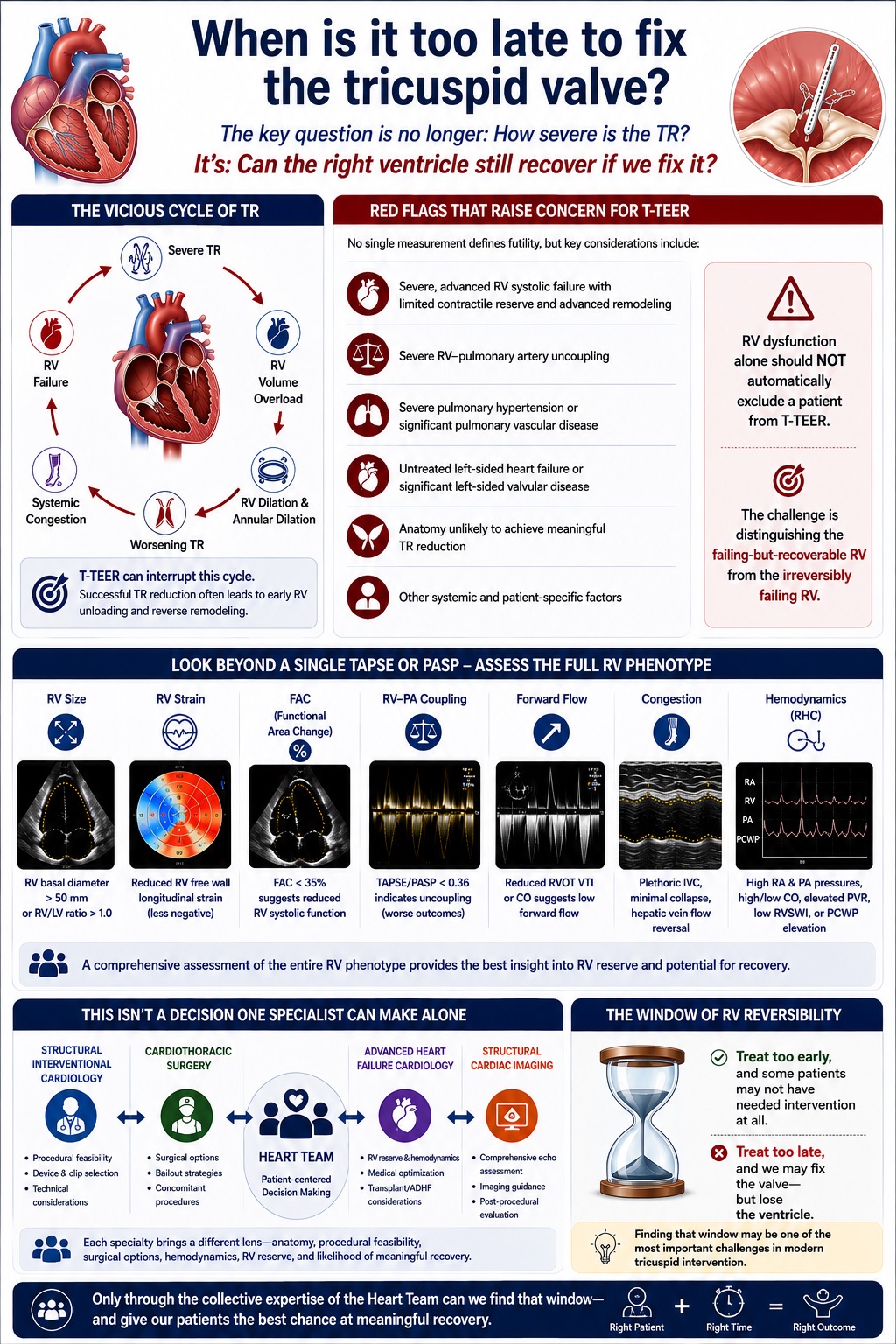
As transcatheter tricuspid edge-to-edge repair (T-TEER) becomes more widely available, the key question is shifting. It's no longer just: How severe is the TR? It's: Can the right ventricle still recover if we fix it?
As transcatheter tricuspid edge-to-edge repair (T-TEER) becomes more widely available, the key question is shifting.
It's no longer just: How severe is the TR?
It's: Can the right ventricle still recover if we fix it?
Severe TR drives a vicious cycle:
TR → RV volume overload → RV dilation → annular dilation → worsening TR → systemic congestion → RV failure
T-TEER can interrupt that cycle. Successful TR reduction can produce early RV unloading and subsequent reverse remodeling.
But there may be a point where fixing the valve is no longer enough.
Red flags that raise concern for T-TEER
There is no single measurement that defines futility, but important considerations include:
• Severe, advanced RV systolic failure with limited contractile reserve and advanced remodeling
• Severe RV–pulmonary artery uncoupling
• Severe pulmonary hypertension or significant pulmonary vascular disease
• Untreated left-sided heart failure or significant left-sided valvular disease
• Anatomy unlikely to achieve meaningful TR reduction
• Other systemic and patient-specific factors
Importantly, RV dysfunction alone should not automatically exclude a patient from T-TEER.
The real challenge is distinguishing the failing-but-recoverable RV from the irreversibly failing RV.
That means looking beyond a single TAPSE or PASP and assessing the entire RV phenotype:
RV size + strain + FAC + RV-PA coupling + forward flow + congestion + end-organ function
This isn't a decision one specialist can make alone.
It requires a true multidisciplinary Heart Team:
• Structural interventional cardiology
• Cardiothoracic surgery
• Advanced heart failure cardiology
• Structural cardiac imaging
Each brings a different lens—anatomy, procedural feasibility, surgical options, hemodynamics, RV reserve, and likelihood of meaningful recovery.
The Window of RV Reversibility
Treat too early, and some patients may not need intervention.
Treat too late, and we may fix the valve—but lose the ventricle.
Finding that window may be one of the most important challenges in modern tricuspid intervention.
Only through the collective expertise of the Heart Team can we give each patient the best chance for a successful intervention and meaningful recovery.
#TricuspidRegurgitation #TTEER #RVFailure #RightVentricle #StructuralHeart #AdvancedHeartFailure #HeartTeam #CardiacImaging #Cardiology
Important notice
This content is for educational purposes only and is not medical advice for any individual patient. Patients should discuss diagnosis and treatment decisions with their own physician, or request a clinical consultation.