September 4, 2026 · Clinical Pearl · Heart Failure Prevention
Statins, Dementia, and the Patient Who Still Says “No”
One of the most persistent concerns I hear from patients is: “I don’t want to take a statin because I’m worried about dementia.” Randomized trials, systematic reviews, and large observational studies have not demonstrated that statins cause dementia or progressive cognitive decline. And if a patient still refuses a statin, we now have more LDL-lowering alternatives than ever.
One of the most persistent concerns I hear from patients is:
“I don’t want to take a statin because I’m worried about dementia.”
Where did this fear come from?
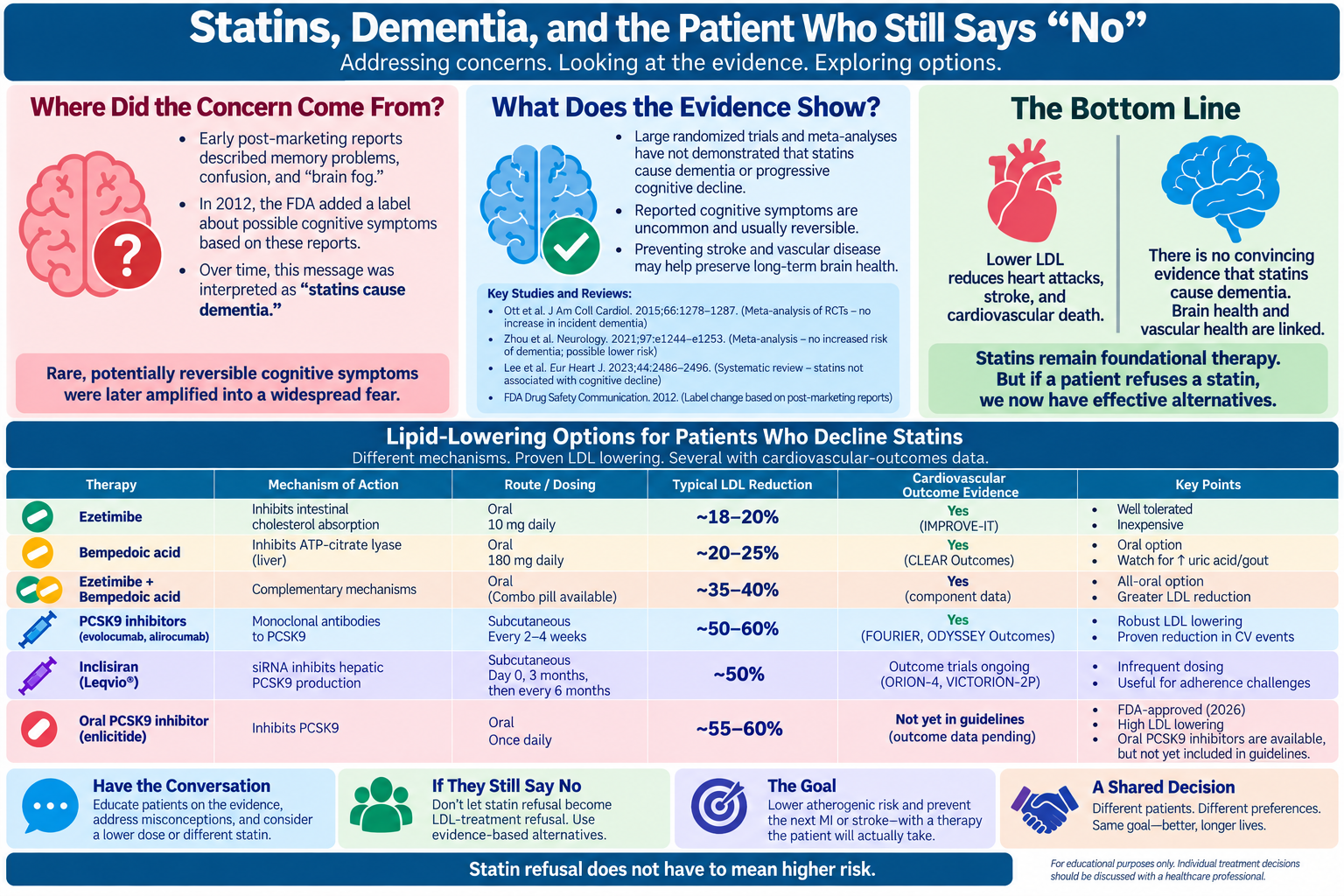
Early post-marketing reports described occasional memory problems, confusion, and “brain fog.” Over time, rare and potentially reversible cognitive symptoms became interpreted as “statins cause dementia.”
But the evidence doesn’t support that conclusion.
Randomized trials, systematic reviews, and large observational studies have not demonstrated that statins cause dementia or progressive cognitive decline. For patients with CAD, prior MI, PAD, or atherosclerotic stroke, preventing vascular events may itself be important for long-term brain health.
But what if the patient still refuses?
Statins remain foundational therapy, but statin refusal shouldn’t become LDL-treatment refusal.
We now have multiple alternatives:
Ezetimibe (Zetia): ~18–20% LDL reduction
Bempedoic acid (Nexletol): ~20–25%
Ezetimibe + bempedoic acid (Nexlizet): ~35–40%
Evolocumab (Repatha) / Alirocumab (Praluent): ~50–60%, with cardiovascular-outcomes data
Inclisiran (Leqvio): ~50%, with twice-yearly maintenance dosing; dedicated cardiovascular-outcomes trials remain ongoing
Enlicitide (Lipfendra): ~55–60% LDL reduction and the first FDA-approved oral PCSK9 inhibitor. It was approved after publication of the 2026 ACC/AHA dyslipidemia guideline, so it is not yet incorporated into the guideline, and dedicated cardiovascular-outcomes evidence is still developing.
This changes the conversation.
We should educate patients, address misconceptions, and consider a different statin or lower dose when appropriate. But if the answer remains “no statin,” we have more alternatives than ever.
Statin refusal does not have to mean untreated LDL.
The goal isn’t simply getting someone to take a statin.
The goal is lowering atherogenic risk and preventing the next MI or stroke—with a therapy the patient will actually take.
#Cardiology #PreventiveCardiology #Cholesterol #LDL #Statins #ASCVD #HeartDisease #PCSK9 #LipidManagement #CardiovascularDisease #StrokePrevention #PatientEducation
Important notice
This content is for educational purposes only and is not medical advice for any individual patient. Patients should discuss diagnosis and treatment decisions with their own physician, or request a clinical consultation.