August 17, 2026 · Clinical Pearl · Heart Failure Prevention
CCTA Is Changing How We Think About Coronary Artery Disease
For years, coronary risk assessment focused heavily on the coronary artery calcium (CAC) score. CAC remains an excellent, validated tool—but it tells us primarily about calcified plaque.
For years, coronary risk assessment focused heavily on the coronary artery calcium (CAC) score.
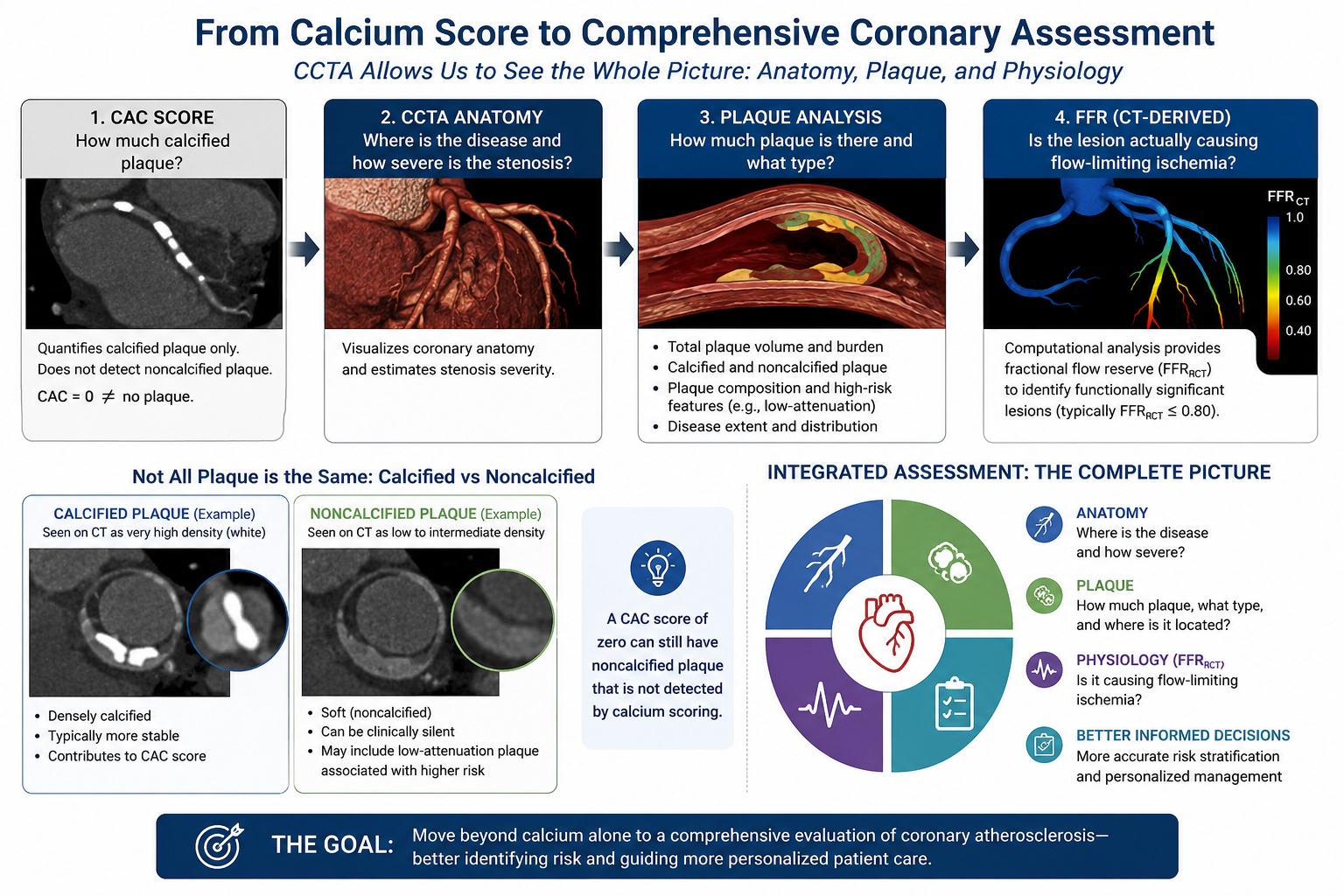
CAC remains an excellent, validated tool—but it tells us primarily about calcified plaque. A calcium score of zero does not necessarily mean an absence of atherosclerosis. Noncalcified plaque can be present before coronary calcium develops.
The evolution of coronary CT angiography (CCTA) is allowing us to look much deeper.
Modern CCTA can increasingly provide a comprehensive assessment of coronary disease:
Anatomy → Plaque → Physiology
Coronary anatomy: Where is the disease and how severe is the stenosis?
Quantitative plaque analysis: What is the total plaque burden, including calcified and noncalcified plaque?
Plaque characterization: Are there low-attenuation or other high-risk plaque features?
CT-derived physiology (FFR-CT): Is a coronary lesion actually producing functionally significant impairment in blood flow?
This represents an important change in how we think about coronary disease.
Rather than simply asking: 'What is the calcium score?'
We can increasingly ask: 'How much atherosclerosis is present, what type of plaque is it, where is it located, and is it affecting coronary blood flow?'
The calcium score isn't disappearing. But CCTA is rapidly evolving from an anatomic test into a much more comprehensive coronary disease phenotyping platform.
The future of coronary risk assessment may increasingly be about understanding the entire disease process—not just the calcium.
#CCTA #CardiacCT #CoronaryArteryDisease #Atherosclerosis #PreventiveCardiology #CardiovascularImaging #PlaqueAnalysis #FFRCT #Cardiology
Important notice
This content is for educational purposes only and is not medical advice for any individual patient. Patients should discuss diagnosis and treatment decisions with their own physician, or request a clinical consultation.