Clinical Pearl · Heart Transplantation
Heart Transplantation: Are Routine Biopsies Becoming a Thing of the Past?
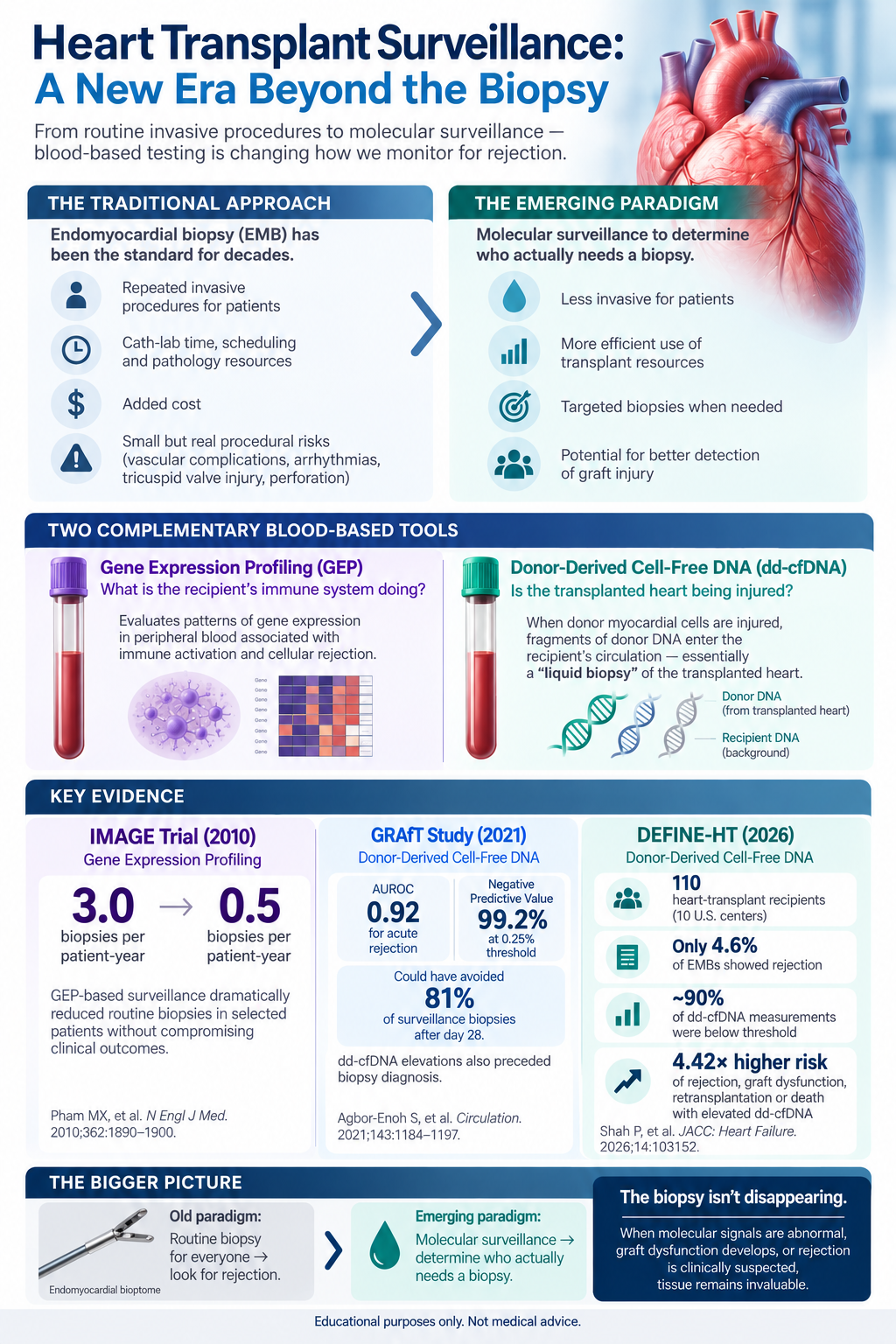
For decades, the endomyocardial biopsy has been one of the necessary burdens of heart transplantation. Two blood-based approaches—gene expression profiling and donor-derived cell-free DNA—are increasingly allowing us to move toward molecular surveillance.
For decades, the endomyocardial biopsy (EMB) has been one of the necessary burdens of heart transplantation.
For patients: repeated invasive procedures. For transplant programs: cath-lab time, pathology, scheduling, cost—and procedural risk.
But technology is changing this paradigm. Two blood-based approaches are increasingly allowing us to move toward molecular surveillance:
• Gene Expression Profiling (GEP) asks: what is the recipient's immune system doing? • Donor-derived cell-free DNA (dd-cfDNA) asks: is the transplanted heart being injured?
When donor cells are injured, fragments of donor DNA enter the recipient's circulation—essentially providing a “liquid biopsy” of the transplanted heart.
The landmark IMAGE trial demonstrated that GEP-based surveillance could dramatically reduce routine biopsies in appropriately selected patients without compromising outcomes.
Now, DEFINE-HT takes the story further. This prospective multicenter study demonstrated that elevated dd-cfDNA identifies heart-transplant recipients at significantly greater risk for rejection, graft dysfunction and other adverse graft outcomes.
The biopsy isn't disappearing. When molecular signals are abnormal, graft dysfunction develops, or rejection is clinically suspected, tissue remains invaluable.
But the philosophy is changing:
Old paradigm: routine biopsy → look for rejection. Emerging paradigm: molecular surveillance → determine who actually needs a biopsy.
After decades of routinely putting a bioptome into transplanted hearts, we are increasingly reaching a point where a blood draw may tell us when we actually need to.
That is a major win for patients—and transplant programs.
Selected references: 1. IMAGE Trial — Pham MX, et al. N Engl J Med. 2010;362:1890–1900. 2. GRAfT Study — Agbor-Enoh S, et al. Circulation. 2021;143:1184–1197. 3. DEFINE-HT — Shah P, et al. JACC: Heart Failure. 2026;14:103152.
Educational purposes only.
#HeartTransplant #TransplantCardiology #ddcfDNA #CellFreeDNA #GeneExpressionProfiling #LiquidBiopsy #EndomyocardialBiopsy #HeartFailure #Rejection #PrecisionMedicine #Cardiology
Important notice
This content is for educational purposes only and is not medical advice for any individual patient. Patients should discuss diagnosis and treatment decisions with their own physician, or request a clinical consultation.